
Concrete Slab Calculator

Concrete Slab & Pad Calculator

Slab Shape

Rectangular covers square slabs and pads

Sets the recommended mix and thickness

10% is the practical standard

4" compacted is typical

Include in estimate:

Reinforcement Type

Concrete Slab Estimate

Enter your slab dimensions above and click "Calculate Concrete" to see your full material estimate.

Enter your dimensions, choose your thickness, and get instant estimates in seconds — that’s really all it takes with this free concrete slab calculator. Whether you’re pouring a backyard patio, a concrete pad for an AC unit, a garage floor, or a full driveway, it works out your cubic yards, bags of concrete, and total project cost in one complete material breakdown, so you know exactly what to buy before you ever mix a batch.

How to Use This Concrete Slab Calculator

  1. Choose shape: Rectangular (covers squares, pads, and driveways) or Circular (round patios, footings, columns)
  2. Enter dimensions: length and width in feet, or diameter for circular slabs
  3. Select project use: sidewalk, patio, shed base, driveway, RV pad, garage, workshop, or house foundation — this sets your recommended concrete strength (PSI) and flags if your thickness is below spec for the job
  4. Select thickness: use the presets (4″ patios, 5″ driveways, 6″ garage floors) or pick Custom thickness to enter your own
  5. Set waste factor: the 10% default covers spillage, uneven subgrade, and over-excavation
  6. Add optional estimates: cost, reinforcement (choose #4 rebar at 12″ or 6×6 wire mesh), gravel base, and excavation
  7. Click Calculate Concrete: get cubic yards, cubic feet, cubic meters, bag counts for 40/60/80 lb, slab weight, truckloads, and an installed cost range
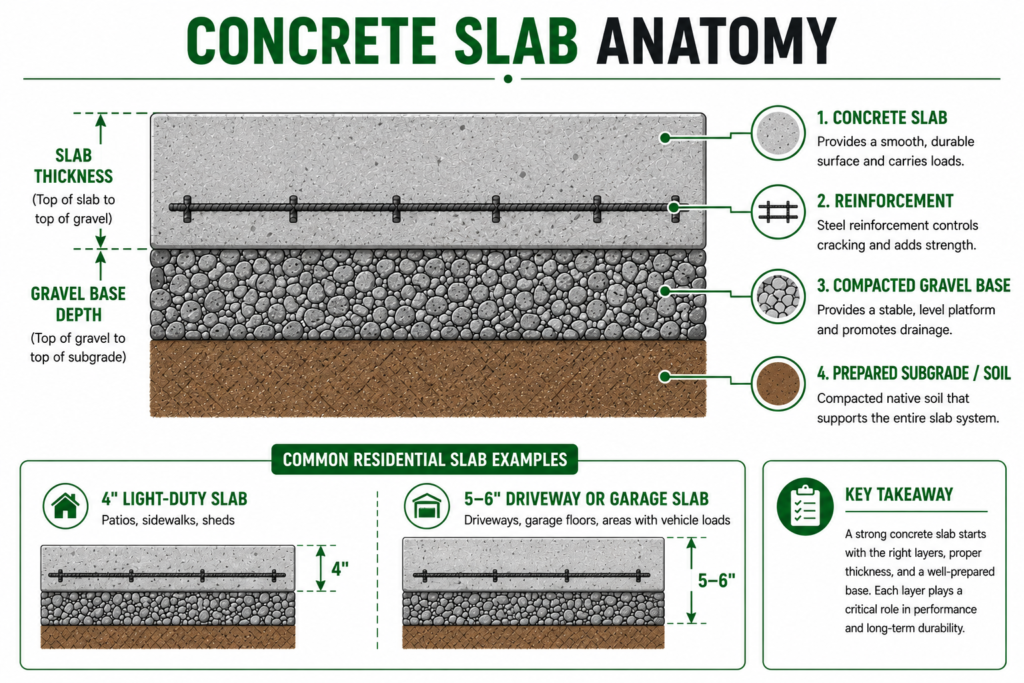
Concrete slab cross section showing slab thickness, gravel base, reinforcement, and ground

What you get back

Beyond the totals, the calculator returns raw volume and ordered volume separately, so the waste allowance is always visible. It recommends bagged vs. ready-mix based on your pour size, and warns about short-load fees under 8 yd³.

A scale slab plan draws your pour with the rebar grid at true 12″ spacing — so the bar count is something you can see, not just take on trust.

An expandable assumptions panel shows the formulas, concrete density (150 lb/ft³), bag yields, and the curing schedule from first set to full 28-day strength. It opens automatically when you print, so your PDF carries the full working.

Results appear when you click, then update live as you adjust anything.

Before you build

Retaining walls are structural. Consult a structural engineer for any wall over 4 feet, and check local building codes — many areas require a permit above a set height. Drainage matters as much as the blocks: without gravel backfill behind the wall, water pressure is what eventually pushes it over.

How the Concrete Slab Calculator Works

Rectangular slab formula
Formula: Length (ft) × Width (ft) × Thickness (in) ÷ 324 = Cubic Yards
The 324 divisor converts inches to feet and cubic feet to cubic yards in one step (12 × 27). A 12 × 12 ft slab at 4″ works out to 1.78 yd³ before waste.
Circular slab formula
Formula: π × Radius² × Thickness (in) ÷ 324 = Cubic Yards
Radius is half your entered diameter. A 10 ft round patio at 4″ comes to 0.97 yd³.
Bags of concrete per cubic yard
Yields: 80 lb = 0.60 ft³ (45 per yd³) · 60 lb = 0.45 ft³ (60 per yd³) · 40 lb = 0.30 ft³ (90 per yd³) Formula: Cubic Yards × Bags Per Yard = Bags Needed
We show all three sizes and round up to whole bags. Counts use your ordered volume, waste included.
Waste factor
Formula: Raw Volume × (1 + Waste ÷ 100) = Ordered Volume
The 10% default covers spillage, uneven subgrade, and over-excavation. Both figures are shown, so the allowance is always visible rather than hidden inside one padded number.
Slab weight
Formula: Cubic Feet × 150 lb/ft³ = Slab Weight
Concrete weighs about 150 lb per cubic foot. A 20 × 20 ft slab at 6″ weighs 30,000 lb — 15 tons. Also shown as pounds per square foot.
Reinforcement
Rebar: #4 bar at 12″ on center both ways. Bars each way = ⌊Dimension ÷ Spacing⌋ + 1 Linear feet = (Bars × Length) + (Bars × Width)
A 20 × 20 slab needs 21 bars each way: 840 linear feet, 42 sticks at 20 ft, about 561 lb.

Wire mesh: Slab Area × 1.10 for sheet overlap, divided into 8 × 20 ft sheets. The same 20 × 20 slab needs 440 ft² — 3 sheets.
Gravel base and excavation
Gravel: Slab Area × Base Depth ÷ 27, converted at 1.4 tons/yd³. Excavation: Slab Area × (Thickness + Base Depth) ÷ 27, then × 1.25 for soil bulking.
Dug soil swells about 25%, so you haul away more than the hole’s volume — a 20 × 20 dig is 12.35 yd³ in the ground but 15.43 yd³ loose.
Ready-mix and truckloads
Formula: Ordered Volume ÷ 10 yd³ per truck = Truckloads
Under about 0.5 yd³, bagged concrete is practical. Past 1 yd³, ready-mix is usually cheaper and faster once delivery is counted.

Orders under 8 yd³ typically attract a short-load fee of $50–$150. Most residential slabs fall below this, so budget for it.
Cost estimate method
Formula: Slab Area (ft²) × Rate = Installed Cost
Based on $6–$12 per square foot installed (USA, 2026), with a typical mid-range of $8–$9. We show low, average, and high, plus the rate used. A 20 × 20 slab lands at $2,400 low, $3,400 average, $4,800 high.

Site prep, demolition, decorative finishes, and difficult access can push costs above this range.

Frequently Asked Questions

Slab concrete starts with area: measure the slab length and width in feet, then multiply length by width to get area. Next, convert the slab thickness from inches to feet — enter it and calculate — then multiply area by thickness to get raw cubic feet. Add waste (typically 5% to 10% extra), then divide by 27 to convert cubic feet into cubic yards, which is how you find the total concrete you need for your slab.

Example: a 10 ft by 10 ft slab at 4 inches thick works out to 100 sq ft times 0.333 ft, or 33.3 cubic feet before waste. With 10% waste, that becomes 36.7 cubic feet, which is about 1.36 cubic yards.

A standard concrete slab should be 4 inches thick for light-duty uses like patios and sidewalks, 5 to 6 inches for driveways or garages, and 8 inches or more for heavy commercial loads. In practice, four inches is standard for patios, walkways, shed floors, and most home slabs, while driveways and slabs carrying vehicles or heavy loads are usually 5 to 6 inches, poured over a compacted gravel base. 

The correct depth for a concrete slab depends on its intended use: 4 inches (100mm) for sheds and patios, 5 to 6 inches (125mm–150mm) for driveways, and 6 inches or more (150mm+) for garages or heavy loads.

You need 0.1 cubic metres (0.1 m³) of concrete per square metre for a standard 100mm (0.1m) deep slab. To find your total, multiply your square metre area by the depth in metres, and always add 5% to 10% extra for waste. It really depends on the depth of your slab.

You need about 5 to 6 cubic yards of concrete for a standard 20×20 foot slab. The exact amount depends on how thick you make the pad, so remember to allow for adding extra for waste.

A 24×24 garage slab requires 7.11 to 10.67 cubic yards of concrete, depending on whether you pour a 4-inch or 6-inch thickness. Always add a 5% to 10% extra waste allowance when ordering.

Slab area is the flat surface space of a floor or roof, measured in square units — think of it as a two-dimensional shape that only takes up space in length and width. Slab volume, whereas, is the total three-dimensional space the slab occupies, including its thickness, measured in cubic units.

You use area to find the size of the surface you’re covering, and volume to find how much material you need to pour.

It’s better to err on the side of caution. Keeping that in mind, ordering a precise amount of concrete for a project is genuinely risky — it’s advisable to include an additional 10 to 15% in your order to cover potential issues such as spillage during the pour, irregular subgrades, and other unforeseen variables. Running out of concrete mid-pour is notably costlier than the expense of ordering extra from the outset: a shortage could delay your project, increase labor costs, necessitate additional truck dispatches, and negatively impact your budget and profit margin.

You need 45 bags of 80-pound concrete to make one cubic yard of mixed concrete — each 80-lb bag yields about 0.6 cubic feet of concrete. To find your exact number, multiply your project’s length by width by depth (in feet), then divide by 27 to get cubic yards, and multiply that by 45.

To calculate an L-shaped slab, split the shape into two smaller rectangles, find the area and volume of each section, and add them together. You can also use online planning tools like the L-Shaped Concrete Calculator to estimate totals.

The absolute minimum slab thickness for a residential concrete driveway is 4 inches, though 5 to 6 inches is frequently recommended for better durability against heavier vehicles.

A thickened edge slab has extra depth along its borders, creating built-in reinforcement that supports posts against both gravity and uplift. In practice, the slab is poured thicker at the edges to form an integral footing, and reinforcing rods strengthen that thickened edge further.

The entire curing period for a concrete slab takes about 28 days, but your concrete will be dry enough to support weight much sooner. Concrete is generally okay to bear the weight of light residential foot traffic after 24 hours, though it’s often a good idea to give it a full 48 hours to cure and gain strength before exposing the slab to heavier foot traffic. You may need to wait a week or longer before you expose it to the weight of vehicles or heavy furniture.

Reinforcement, yes tick “Reinforcement estimate” and choose #4 rebar at 12″ on center or 6×6 wire mesh. You get linear feet, sticks, and weight for rebar, or square feet and sheet count for mesh.

Partly. It gives volume in cubic meters alongside cubic feet and yards, so you can order metric quantities. It doesn’t convert to European grades — all strength recommendations are in PSI. Dimensions are entered in feet, so convert first (1 m = 3.28 ft).

Yes. The Waste Factor defaults to 10%, covering spillage and uneven subgrade. Ordered Volume = Raw Volume × (1 + Waste ÷ 100)