
Concrete Block Weight Calculator
Concrete Weight Estimation
Select your block specifications and click "Calculate Weight" to see estimates.
Specification Summary
Weight estimates are approximate. Actual unit weight varies with aggregate, moisture content and manufacturer. Verify with your supplier before planning lifts or deliveries.
Whether you’re designing a retaining wall, estimating freight costs for a flatbed truck, or determining if a patio foundation can support a heavy load, knowing exactly how much concrete weighs is critical. Concrete is a remarkably dense material, and guessing its weight can lead to structural failures, severe transport violations, or equipment damage. Our comprehensive concrete block weight calculator removes the guesswork entirely: it instantly determines the volume and weight of custom poured blocks, precast barrier walls, standard cinder blocks, and flat concrete slabs, doing the heavy math for you. This tool serves as a reliable concrete load calculator for both DIYers and contractors.
Need to calculate concrete weight for a slab or masonry wall? This concrete weight calculator helps you weigh your materials accurately — it supports hollow core CMUs, custom densities, barrier walls, and custom slabs, and can find the weight of a circular slab or standard blocks with a precise estimation in lbs and kg. It also estimates the volume and weight of concrete necessary to cover a given area, so purchasing slightly more concrete than the estimated result can reduce the probability of ending up with insufficient concrete on-site.
How to Use This Retaining Wall Block Calculator
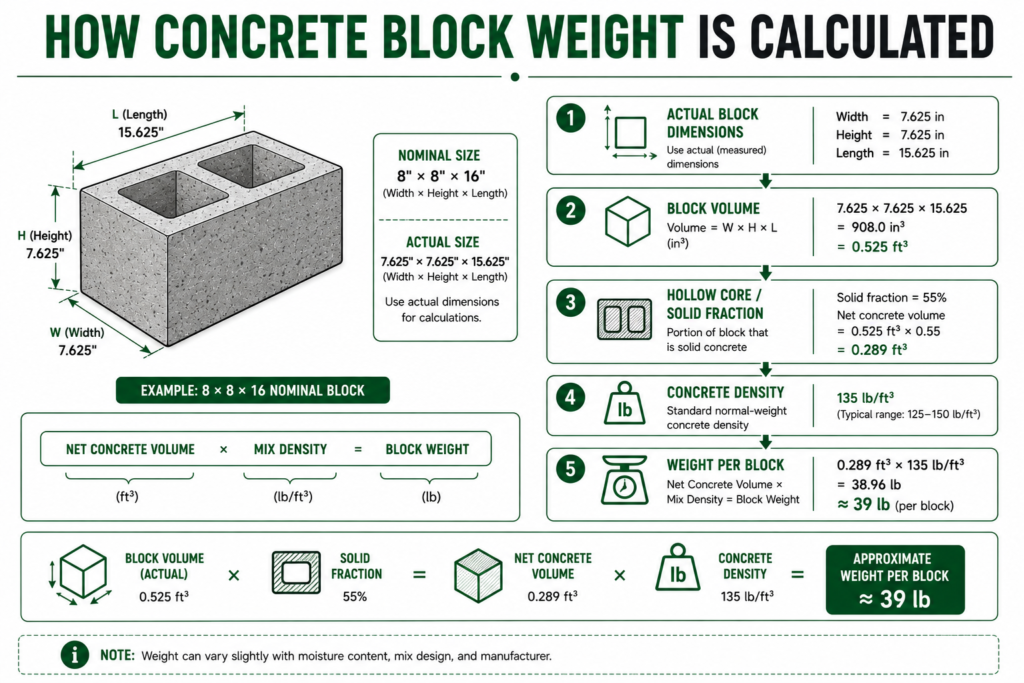
- Block Size: Pick 4″, 6″, 8″, or 12″ CMU. The calculator uses actual dimensions (an 8×8×16 block really measures 7⅝ × 7⅝ × 15⅝ inches), not the nominal size.
- Block Type: Choose Standard Weight, Lightweight, or Heavyweight/Dense. This sets the aggregate density of the mix — the same 8″ block weighs 39 lb standard, 29.8 lb lightweight, or 47.7 lb heavyweight.
- Number of Blocks: Enter how many blocks are in the job.
- Block Configuration: Select Hollow (2–3 cores, the usual case) or Solid/Filled. Filling the cores nearly doubles the weight — an 8″ block goes from 39 lb to 71 lb.
- Calculate Weight: Get weight per block and total, in pounds, kilograms, US tons, and tonnes.
What you get back
Beyond the weight, the calculator returns:
- Pallets — full pallets plus loose blocks. 100 × 8″ blocks is 1 full pallet (90 per pallet) plus 10 loose.
- Vehicle needed — the smallest truck that carries the load in one trip, compared across half-ton, ¾-ton, 1-ton, and trailer, with trip counts for each.
- Transport warning — flags when the load exceeds a typical half-ton pickup’s payload. 100 × 8″ blocks weigh 3,903 lb, which is well past it.
- Concrete volume and the mix density used, so the number is auditable.
A scale plan section draws the block from above, showing its real core count and face-shell thickness — cores fill solid when you switch to Solid/Filled.
Results appear when you click, then update live. Use Print / Save PDF for a spec sheet or Copy Results to paste into an order.
Before you order
Weights are approximate. Actual unit weight varies with aggregate, moisture content, and manufacturer — a block that’s been sitting in rain weighs noticeably more than a dry one. Pallet counts also vary by yard.
Vehicle payloads shown are conservative. Subtract passengers, tools, and tongue weight, and never exceed your door-jamb sticker. Confirm with your supplier before planning a lift or a delivery.
How the Concrete Block Weight Calculator Works
Weight per block
Solid fraction and cores
| Size | Solid | Cores |
|---|---|---|
| 4″ | 70% | 3 |
| 6″ | 60% | 2 |
| 8″ | 55% | 2 |
| 12″ | 52% | 3 |
Mix density
Total weight and volume
Pallets
Vehicle and transport
Accuracy
Frequently Asked Questions
Related Calculators
Estimating a bigger project? These tools work well together.