
Fire Pit & Planter Concrete Block Calculator
Materials Needed and Layout
Enter your project dimensions and click "Calculate Materials" to see estimates.
Project summary
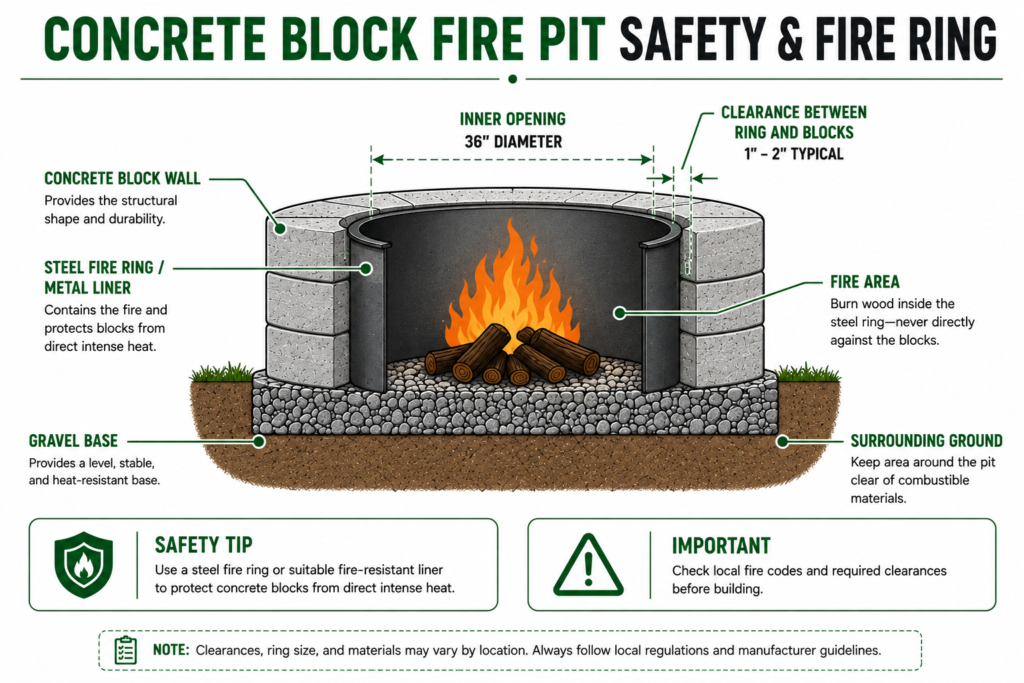
Fire pits must comply with local fire codes. Keep a pit 15–20 ft from any structure, and never use standard CMU as the inner face of a wood fire without a steel liner or firebrick.
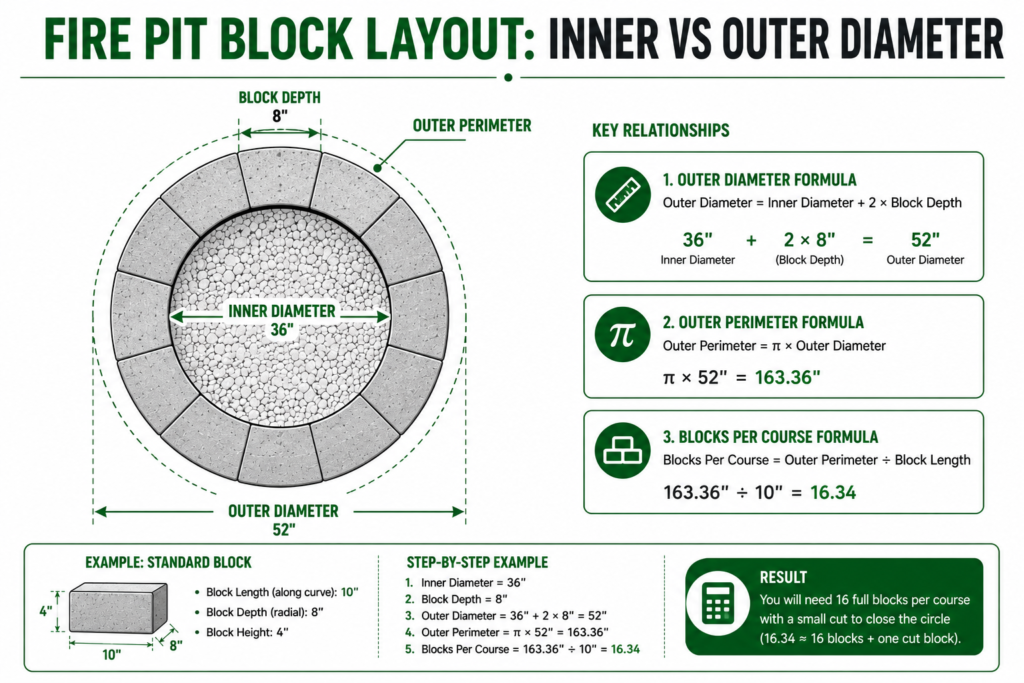
Building a fire pit or planter starts with knowing how many blocks you need. Underbuying is the most common mistake — most people estimate from a rough perimeter guess instead of measuring precisely around the block layout itself, and on a 36-inch pit that gap alone is four or five blocks per course.
This calculator handles the geometry for you: enter your inner diameter or side length, and the calculator adds block depth to find the true outer perimeter the blocks follow, choose your block type, set the number of courses, and get blocks per course, an exact total, and a recommended order quantity with 10 percent added for cuts and waste. It covers circular and square designs, with auto-filled block dimensions for retaining wall blocks, bricks, or cinder blocks.
How to Use Firepit Concrete Block Calculator
Shape & Dimensions
- Pick your project — Fire Pit or Planter. Planters get a soil estimate; fire pits get a fire ring option.
- Pick a shape — Circular, Square, or Rectangular. The fields change to match: diameter for round, length for square, length and width for rectangular.
- Measure the inside, not the outside. Enter the open space you want; the calculator adds the block thickness itself.
- Set Number of Rows — how many courses high. Three rows of 8″ block gives a 24″ wall.
Wall & Capstone Blocks
- Choose Block Size — 4″, 6″, or 8″ CMU (all 8×16 face), or Retaining Wall Block (6″ high × 12″ long, 8″ deep). Shorter blocks mean more units per course.
- Set Waste Percentage — 5% for a simple ring, more for square and rectangular builds that need corner cuts.
- Tick extras — cap stones adds a finishing course; fire ring adds a steel liner sized to your opening (fire pits only).
Safety
Keep a fire pit 15–20 feet from any structure, fence, or overhanging branches, and check local fire codes first. Never use plain CMU as the inner face of a wood fire without a steel liner or firebrick — trapped moisture can make block crack or spall when heated.
How We Calculate
Blocks Per Course
Total Blocks
Cap Stones
Gravel Base
Planting Soil (planters only)
Fire Ring Insert (fire pits only)
Waste Factor
Common Fire Pit Sizes
| Inner Diameter | Blocks per Course (16″ block) | Courses | Total Blocks (approx.) |
|---|---|---|---|
| 30″ | 6 | 3 | 18–20 |
| 36″ | 7–8 | 3 | 22–24 |
| 48″ | 13 | 2 | 26-29 |
Note: this brick count is for standard bricks (much smaller than CMU blocks), not the 16-inch concrete blocks used elsewhere on this page — that’s why the number is higher.
Cap Block Calculation Example
For a 36-inch pit with 8 blocks per top course, add 8 cap blocks (one per block position) to finish the wall — cap blocks are ordered separately from wall blocks and typically add 10-15% more waste allowance due to precision cutting at the curve.
Gravel Base & Depth
A standard gravel base runs 4 to 6 inches deep, extending slightly beyond the outer edge of your block layout for stability and drainage.
Recommended Fire Pit Height
Most builds use 2, 3, or 4 courses: 2 courses (about 8 inches) suits low, decorative pits; 3 courses (12–16 inches) is the most common backyard height; 4 courses (16–20 inches) suits taller, wind-sheltered designs.
Wood-Burning vs Gas Fire Pits
Wood-burning pits need an open top and enough interior depth for airflow and ash cleanup. Gas fire pits typically require a smaller footprint but need extra space inside the block ring for a burner pan and gas line — check burner specifications before finalizing block count.
DIY Fire Pit: How to Build an Easy Cinder Block Fire Pit
Watch this DIY tutorial showing how to build a budget-friendly cinder block fire pit, including the basic block layout and construction approach.
Frequently Asked Questions
Related Calculators
Estimating a bigger project? These tools work well together.