
Concrete Block Weight Calculator
Concrete Weight Estimation
Select your block specifications and click "Calculate Weight" to see estimates.
Specification Summary
Weight estimates are approximate. Actual unit weight varies with aggregate, moisture content and manufacturer. Verify with your supplier before planning lifts or deliveries.
Whether you’re designing a retaining wall, estimating freight costs for a flatbed truck, or determining if a patio foundation can support a heavy load, estimating the weight of the specified masonry units is useful for early planning, but product weights vary. Concrete is a remarkably dense material, and guessing its weight can lead to structural failures, severe transport violations, or equipment damage. Our comprehensive concrete block weight calculator removes the guesswork entirely: it estimates the weight of common concrete masonry units using the selected nominal block size, density class, hollow or solid configuration, and number of blocks. Use these approximate CMU weights for preliminary planning only; confirm actual unit and pallet weights and vehicle limits with your supplier and transport provider.
Need to calculate concrete weight for a slab or masonry wall? This concrete weight calculator helps you weigh your materials accurately — it estimates weights for preset CMU sizes and density categories, hollow or solid configurations, and block quantities, returning approximate results in pounds and kilograms; it does not accept custom slab or barrier dimensions. This tool estimates CMU shipment weight, not poured-concrete slab volume. For actual shipping loads, confirm individual block weights and pallet quantities with the supplier.
Pouring a slab? Use our concrete slab calculator to work out cubic yards, bags, rebar, and cost.
How to Use This Block Weight Calculator
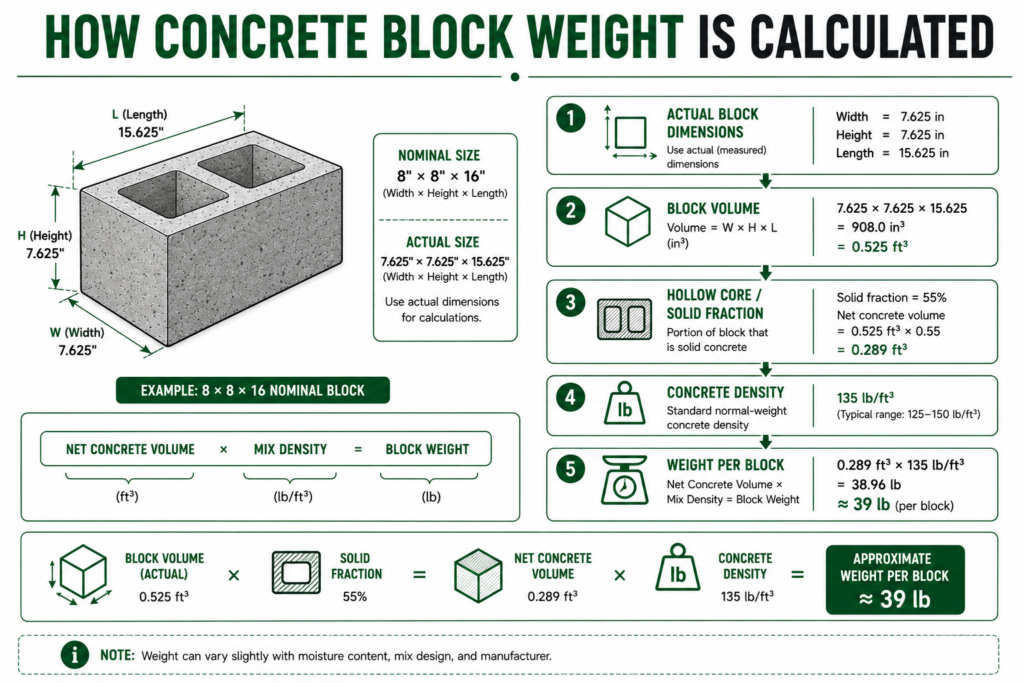
- Block Size: Pick 4″, 6″, 8″, or 12″ CMU. The calculator uses actual dimensions (an 8×8×16 block really measures 7⅝ × 7⅝ × 15⅝ inches), not the nominal size.
- Block Type: Choose Standard Weight, Lightweight, or Heavyweight/Dense. This sets the aggregate density of the mix — the same 8″ block weighs 39 lb standard, 29.8 lb lightweight, or 47.7 lb heavyweight.
- Number of Blocks: Enter how many blocks are in the job.
- Block Configuration: Select Hollow (2–3 cores, the usual case) or Solid/Filled. Filling the cores nearly doubles the weight — an 8″ block goes from 39 lb to 71 lb.
- Calculate Weight: Get weight per block and total, in pounds, kilograms, US tons, and tonnes.
What you get back
Beyond the weight, the calculator returns:
- Pallets — full pallets plus loose blocks. 100 × 8″ blocks is 1 full pallet (90 per pallet) plus 10 loose.
- Vehicle needed — the smallest truck that carries the load in one trip, compared across half-ton, ¾-ton, 1-ton, and trailer, with trip counts for each.
- Transport warning — flags when the load exceeds a typical half-ton pickup’s payload. 100 × 8″ blocks weigh 3,903 lb, which is well past it.
- Concrete volume and the mix density used, so the number is auditable.
A scale plan section draws the block from above, showing its real core count and face-shell thickness — cores fill solid when you switch to Solid/Filled.
Results appear when you click, then update live. Use Print / Save PDF for a spec sheet or Copy Results to paste into an order.
Before you order
Weights are approximate. Actual unit weight varies with aggregate, moisture content, and manufacturer — a block that’s been sitting in rain weighs noticeably more than a dry one. Pallet counts also vary by yard.
Vehicle payloads shown are conservative. Subtract passengers, tools, and tongue weight, and never exceed your door-jamb sticker. Confirm with your supplier before planning a lift or a delivery.
How the Concrete Block Weight Calculator Works
Weight per block
Solid fraction and cores
| Size | Solid | Cores |
|---|---|---|
| 4″ | 70% | 3 |
| 6″ | 60% | 2 |
| 8″ | 55% | 2 |
| 12″ | 52% | 3 |
Mix density
Total weight and volume
Pallets
Vehicle and transport
Accuracy
Frequently Asked Questions
Related Calculators
Estimating a bigger project? These tools work well together.