
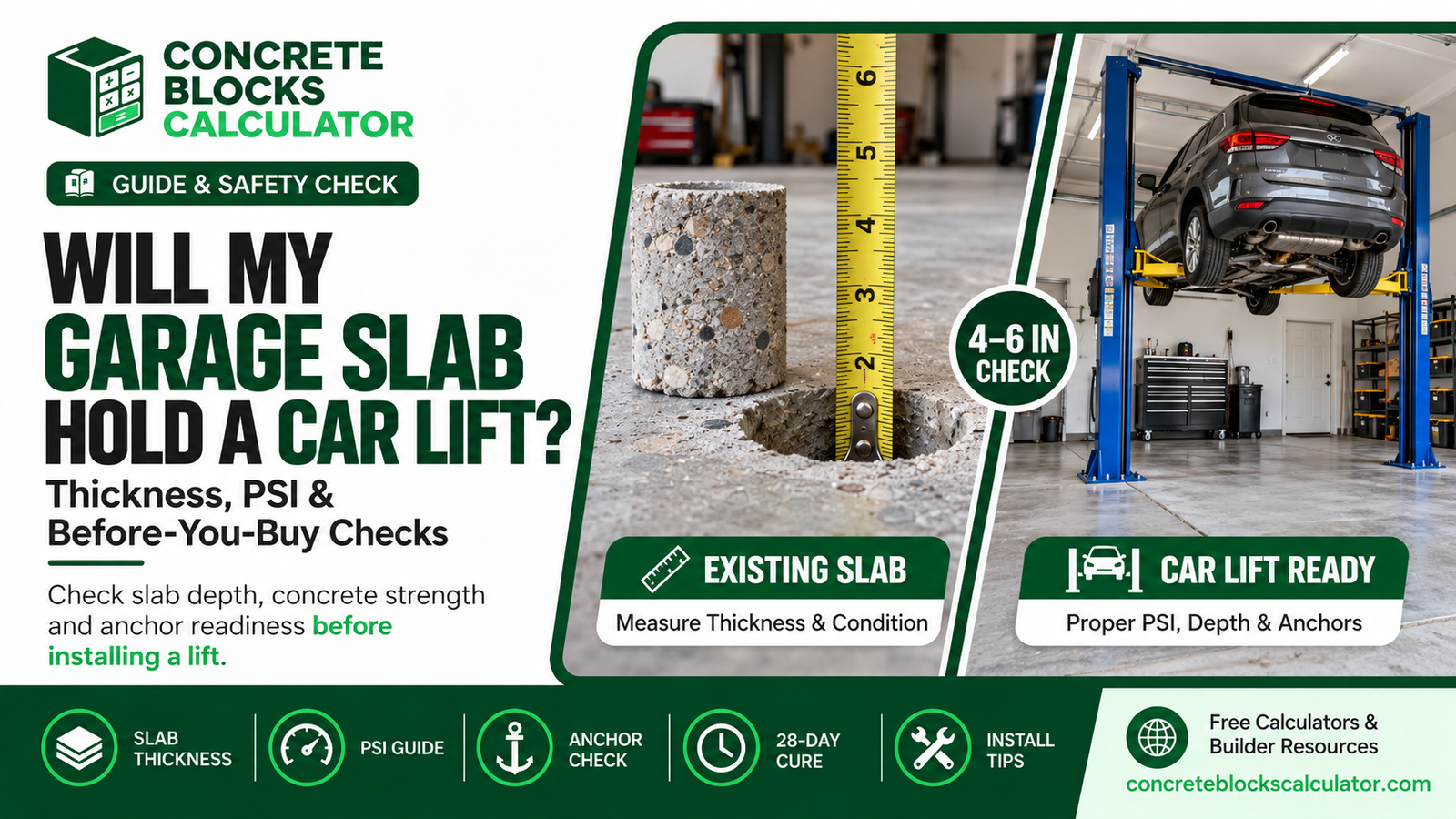
Will My Existing Garage Slab Hold a Car Lift? How to Check Before You Buy
The short answer: some lift models specify minimum slab dimensions and concrete strength, but there is no safe universal thickness: check the specific lift manufacturer’s manual. Common published examples start at 4 inches of concrete, 6 inches is recommended, at 3,000–4,000 PSI, cured for 28 days.
But that is the generic answer — and the only answer that actually governs your garage is your lift manufacturer’s manual. Different lifts, capacities, and anchor systems have different requirements, and the manual wins over any article.
Before you order a lift, check the slab you already have. Here is how.
1 Find your lift’s requirement
Check the manual for three numbers: minimum slab thickness, minimum PSI, and anchor embedment depth. As a guide only, typical figures are:
| Lift type | Typical minimum thickness | Typical recommended |
|---|---|---|
| 2-post, 8,000–10,000 lb | 4 inches | 6 inches |
| 2-post, 12,000–15,000 lb | 6 inches | 6–8 inches |
| 4-post, most residential | 4 inches | 4–6 inches |
These figures vary by manufacturer. One brand’s 10,000 lb lift may demand 6 inches where another accepts 4. Do not buy on the generic table. Buy on your manual.
2 Measure your actual slab
Do not trust the plans or the builder’s word. Slabs are routinely thinner than specified, and they vary across the floor. Check thickness at several points, especially where the lift posts will stand:
- At an edge or crack where the slab’s cross-section is visible.
- By drilling a small core or test hole at each post location and measuring depth with a wire or probe. The thinnest measurement governs — if three spots read 6 inches and one reads 3.5, you have a 3.5-inch slab for lift purposes.
- Note the age and condition. A 30-year-old slab with wide cracks, settlement, or previous patching is a different case from a sound 5-year-old slab, even at the same thickness. Cleaning a garage floor first also makes cracks and damage easier to see: How to Clean Concrete Floors.
If you cannot confirm thickness or PSI, treat the slab as unknown and get it assessed before drilling anchors. Anchors in a thin slab can pull out, and a falling vehicle is not a repairable mistake.
3 If the slab is too thin — cut-out pads or full repour?
You usually do not need to replace the whole floor. The standard fix is cut-out footings: saw-cut a square at each post location, excavate, and pour a deeper reinforced pad (typically 6–8 inches, reinforced, and tied to the surrounding slab) that the lift anchors into.
This is far cheaper than a full repour and is what most installers do for thin slabs.
A full repour makes sense only when the whole slab is failing — widespread cracking, settlement, or drainage problems — or when you are already replacing the floor for other reasons.
After any new pad is poured, wait the full 28 days before drilling anchors and loading the lift. Fresh concrete reaches working strength gradually, and anchors set early can fail.
Anchor basics
Typical 2-post anchors are 3/4-inch by 5-1/2-inch wedge anchors needing about 3-1/4 inches of embedment, plus edge-distance rules (anchors must sit a minimum distance from slab edges and joints).
If your post location lands on a control joint or too close to an edge, move the lift or pour a pad — do not drill into the joint.
The bottom line
Check your manual first, measure your slab second, and let the thinnest measurement decide. If it is too thin, cut-out pads usually solve it for a fraction of a repour. Planning a new garage slab? Run the numbers with our concrete slab calculator and spec it for the lift from day one — 6 inches and rebar is cheap insurance when the concrete is already being poured.
Frequently Asked Questions
How thick does a garage slab need to be for a 2-post car lift?
There is no universal minimum. Follow the exact lift manufacturer’s slab thickness, strength, reinforcement, age, and anchor requirements. If the slab’s properties are unknown, have it evaluated before installation.
How do I check my existing slab thickness?
Measure at edges and by drilling small test holes at each post location. The thinnest reading governs, not the average.
Can I install a lift on a 4-inch slab?
Many 8,000–10,000 lb 2-post lifts allow 4 inches, but many installers and manufacturers recommend 6. Check your specific manual before buying.
What if my slab is too thin for a lift?
Cut-out reinforced pads at each post location are the usual fix — much cheaper than replacing the whole floor.
How long after pouring must I wait before installing a lift?
28 days for full cure before drilling anchors and loading the lift.
One Comment