Cinder Block vs Concrete Block
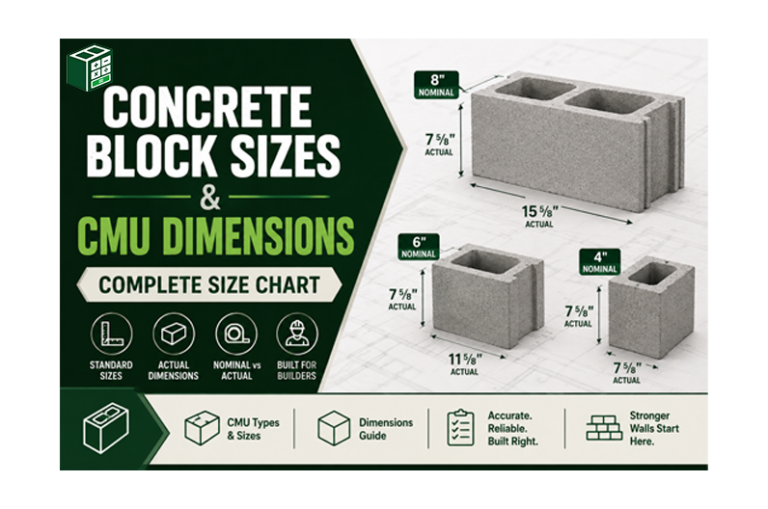
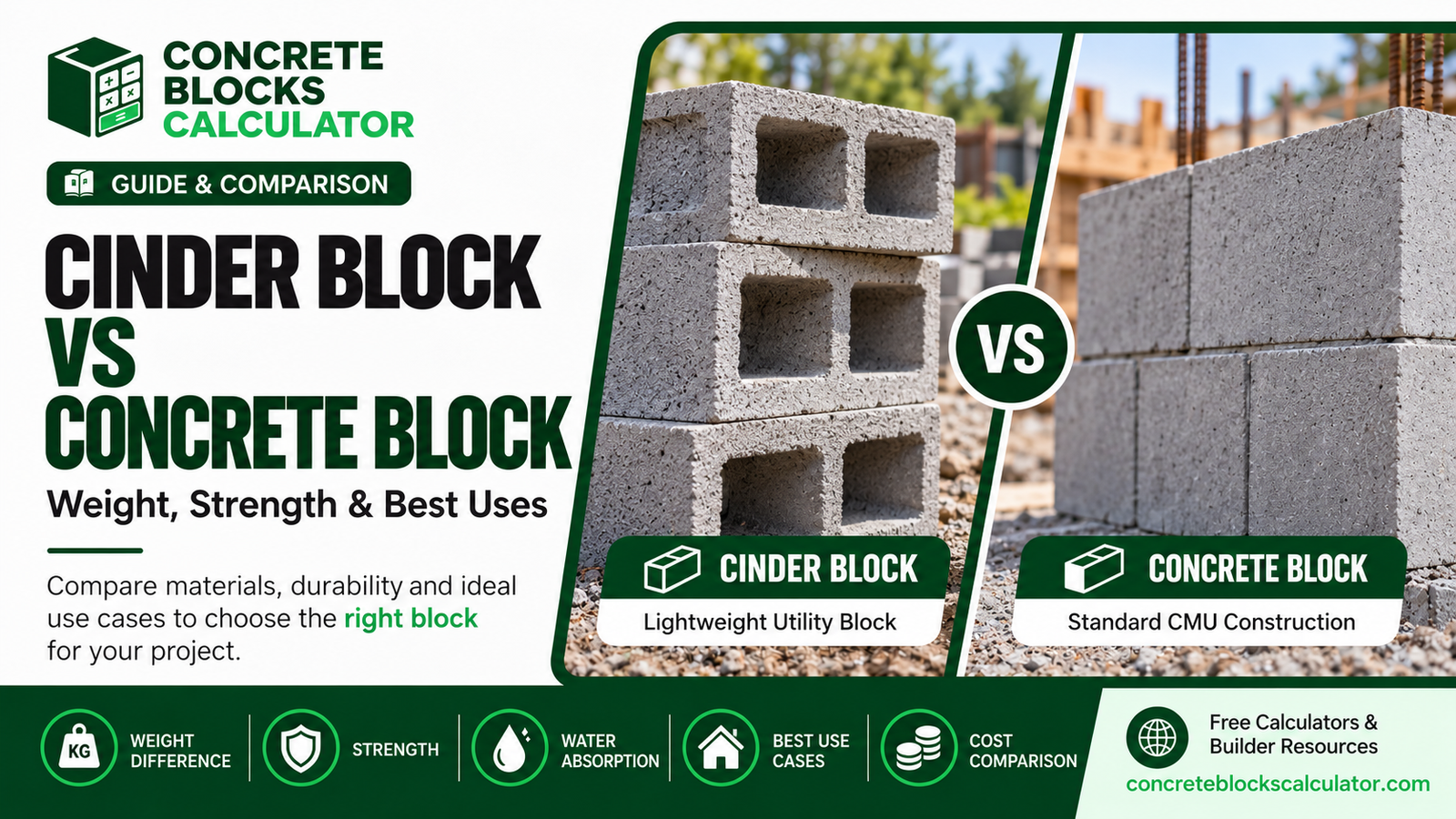
A “cinder block” was originally a concrete block made with coal cinders as the aggregate; a concrete block (CMU) uses sand, gravel, or crushed stone. True cinder blocks are rare today — what US home centers sell as “cinder blocks” are almost always just lightweight concrete blocks, and the old name stuck. For estimating, first confirm the actual product size; a standard full-face CMU may be nominally 8×8×16 inches, both need 113 blocks per 100 sq ft with 3/8-inch joints.
The history in 30 seconds
In the early 1900s, block makers used waste coal cinders — the ash left after burning coal — as the lightweight aggregate in their mix. The result was the “cinder block”: lighter and cheaper than stone-aggregate blocks. As coal heating faded, cinders disappeared, and manufacturers switched to expanded shale, clay, or slate for lightweight units. The product changed; the nickname didn’t.
Head-to-head comparison
| Concrete block (CMU) | Cinder block (modern “cinder”) | |
|---|---|---|
| Aggregate | Sand, gravel, crushed stone | Expanded shale, clay, or slate (lightweight) |
| Weight (8×8×16) | ~28–35 lbs | ~22–28 lbs |
| Compressive strength | Depends on product specification and tested strength; ASTM C90 covers loadbearing CMUs | Not established by the nickname: lightweight CMUs can also meet ASTM C90 |
| Best for | Load-bearing walls, foundations, retaining walls | Garden walls, partitions, sheds |
| Cost per block (US retail) | ~$2.50–$4.00 | ~$0.25–$0.75 less per block |
| Water absorption | Lower | Higher (seal if exposed to weather) |
| Fire resistance | Excellent (up to 4-hour rated assemblies) | Good, but lower mass = lower rating |
Strength, standards, and building code
This is where the difference actually matters in the US. Concrete masonry is governed by ASTM standards, and your building inspector cares about them:
- ASTM C90 covers loadbearing concrete masonry units — minimum 2,000 psi compressive strength. Foundations, load-bearing walls, and structural retaining walls need C90 units.
- ASTM C129 covers nonloadbearing units — fine for partitions, veneer backup, and landscape walls that hold nothing up.
The practical rule: if the wall holds up a building or holds back serious soil, buy C90 concrete block — full stop. If your project needs a permit, the inspector will want to see the ASTM rating, and most blocks stocked at Home Depot and Lowe’s are C90 anyway. When in doubt, read the stamp on the block or ask the pro desk.
Slab projects follow the same local-rules logic, but the answer depends on what the slab is for — patio, driveway apron, or structure. See: Do I Need a Permit for a Concrete Slab?
What they cost in the US
At big-box stores in 2026, a standard gray 8×8×16 concrete block typically runs $2.50–$4.00 depending on your region (the Southeast and Texas tend to be cheapest; the Northeast and West Coast run higher). The lightweight “cinder” version usually costs $0.25–$0.75 less per block.
Put it in project terms: a 200-block garden wall at $3.00/block is $600 in block; the lightweight version saves you roughly $50–$150. That’s real money on a decorative wall — and completely irrelevant on a foundation, where using the cheaper block to save $100 would be a costly mistake. Specialty units (split-face, colored, or scored architectural block) run $4–$8+ each regardless of type.
Which block for your project
Foundation or basement walls: Standard CMU, C90, cores grouted and reinforced with rebar. Non-negotiable — this is the one place the “cinder” question has a hard answer: no.
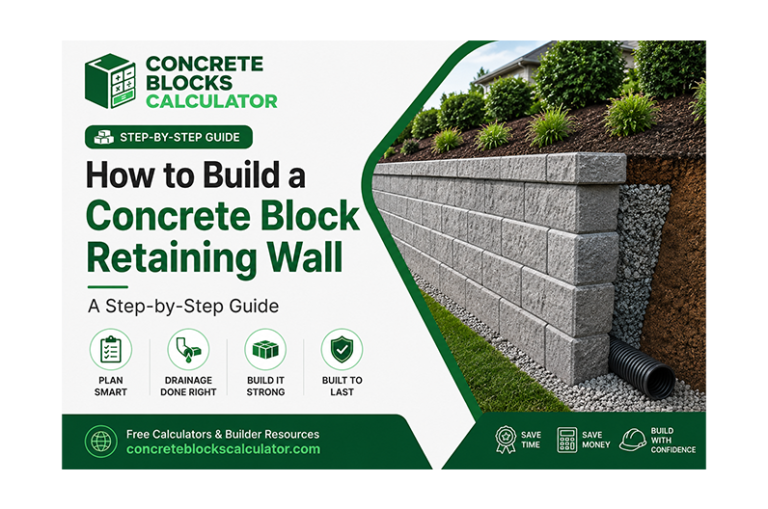
Retaining walls: For small landscape walls under 2–3 feet, lightweight blocks are fine and easier on your back. For anything taller, holding back real soil pressure, or supporting a surcharge (driveway, slope) above — use standard CMU with rebar and grout. Walls over 4 feet typically need engineering, and requirements vary by locality, so check before you build.
Shed, garage, or stem walls: Standard CMU. The cost difference is trivial at this scale and the strength margin is worth it. If that garage will hold a car lift, the slab matters as much as the walls — check that your slab is thick enough before you buy the lift: Will My Garage Slab Hold a Car Lift?
Fire pit: Concrete blocks are fine for the outer ring, but line the inside with fire brick — standard block can crack and spall under direct, repeated flame. Plan the ring with our Fire Pit Calculator first so you buy the right count.
Raised garden beds: Lightweight “cinder” blocks are ideal — cheap, easy to move, and strong enough. Modern blocks are fine around vegetables; line the inside with landscape fabric to keep soil in.
Fence posts, mailbox piers, columns: Standard CMU, and fill the cores with concrete for mass. These take wind load and the occasional bump from a mower.
Interior non-loadbearing partitions: Lightweight blocks win — easier to carry, cut, and hang on a slab.
Hauling them home: truck and pallet math
This is the question nobody asks until they’re staring at a pallet in the parking lot:
- A pallet (cube) of 8×8×16 blocks holds roughly 90 blocks and weighs 2,500–3,000 lbs. Get it delivered — that exceeds what most half-ton pickups can legally carry.
- A typical half-ton pickup payload is 1,500–2,000 lbs, which means roughly 50–65 standard blocks per trip (60 blocks × 30 lbs = 1,800 lbs — right at the limit).
- Switching to lightweight blocks buys you about 25% more blocks per trip. On a big DIY wall, that can save you a whole run to the store.
Strap the load, distribute weight over the axles, and drive like the blocks are worth more than the truck — because replacing a blown-out tire on the highway costs more than delivery would have.
Mortar and installation: no difference
Both types lay with the same Type N or Type S mortar, the same 3/8-inch joints, and the same tools. If you can lay one, you can lay the other — the lightweight units are just friendlier to your arms over a long day.
Estimating: no difference
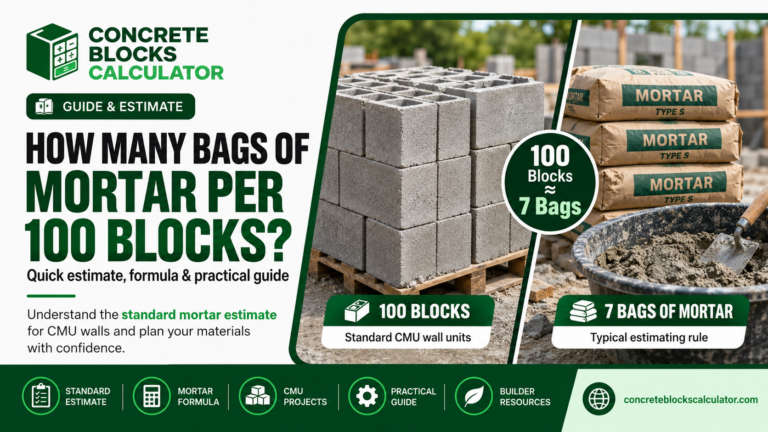
Same nominal face (8×16 in), same math: wall sq ft × 1.125 = blocks, plus 5–10% waste. Mortar: about 2¼ bags of 70-lb masonry cement (plus sand) per 100 blocks either way. Our calculator’s block-size dropdown covers both — just pick your unit and it handles the rest. Double-check the haul weight with our Block Weight Calculator before you drive to the store.
What to ask for at the store
At Home Depot or Lowe’s, the shelf tag says “concrete block” — if you ask an associate for “cinder blocks,” they’ll walk you to the same aisle. True coal-cinder blocks effectively don’t exist in US retail anymore, so don’t hunt for them. What you actually choose between is standard weight vs. lightweight, and the guidance above tells you which one your project needs.
Frequently asked questions
Are cinder blocks and concrete blocks the same thing?
Not originally — cinder blocks used coal cinders as aggregate, concrete blocks (CMU) use sand and stone. Today, what US stores sell as “cinder blocks” are just lightweight concrete blocks. The names are used interchangeably at retail, but the products differ in weight and strength.
Which is stronger, cinder block or concrete block?
The name alone does not tell you which unit is stronger. ASTM C90 covers normal-, medium-, and lightweight loadbearing CMUs. For a structural project, verify the unit specification, tested compressive strength, and engineered design requirements rather than choosing by the label “cinder block”.
Are cinder blocks cheaper than concrete blocks?
Slightly — usually $0.25–$0.75 less per block at US home centers. On a 200-block wall that saves roughly $50–$150, which matters for a garden bed and doesn’t matter for a foundation.
Can you still buy real cinder blocks?
Essentially no, at least not in the US retail market. If a listing says “cinder block,” it’s a lightweight concrete block wearing a vintage name.
Can I use cinder blocks for a foundation?
No. Foundations and basement walls need loadbearing CMU rated to ASTM C90, with grouted cores and rebar. This is also a code issue — an inspector will flag non-rated units.
Are cinder blocks OK for a retaining wall?
For small landscape walls under 2–3 ft, yes. For anything taller or holding back real soil pressure, use standard CMU with rebar and grout — and check whether your wall needs engineering (generally over 4 ft, varies by locality).
Do cinder blocks and concrete blocks weigh the same?
No — that’s the main practical difference. A lightweight “cinder” 8×8×16 runs roughly 22–28 lbs versus 28–35 lbs for a standard-weight CMU. That 25% difference is why DIYers prefer them for garden projects — and why you should run your count through our Block Weight Calculator before loading the truck.
Can you use cinder blocks for a fire pit?
For the outer ring, yes — but line the fire-facing inside with fire brick. Standard concrete block can crack and spall under direct, repeated high heat.
Are concrete blocks safe for a vegetable garden?
Yes. Modern concrete blocks are fine around food plants. Line the inside with landscape fabric to keep soil from washing through the cores.
What does CMU stand for?
Concrete Masonry Unit — the industry term for what most people call a concrete block or cinder block.