How Much Is a Yard of a Concrete in the USA in 2026?
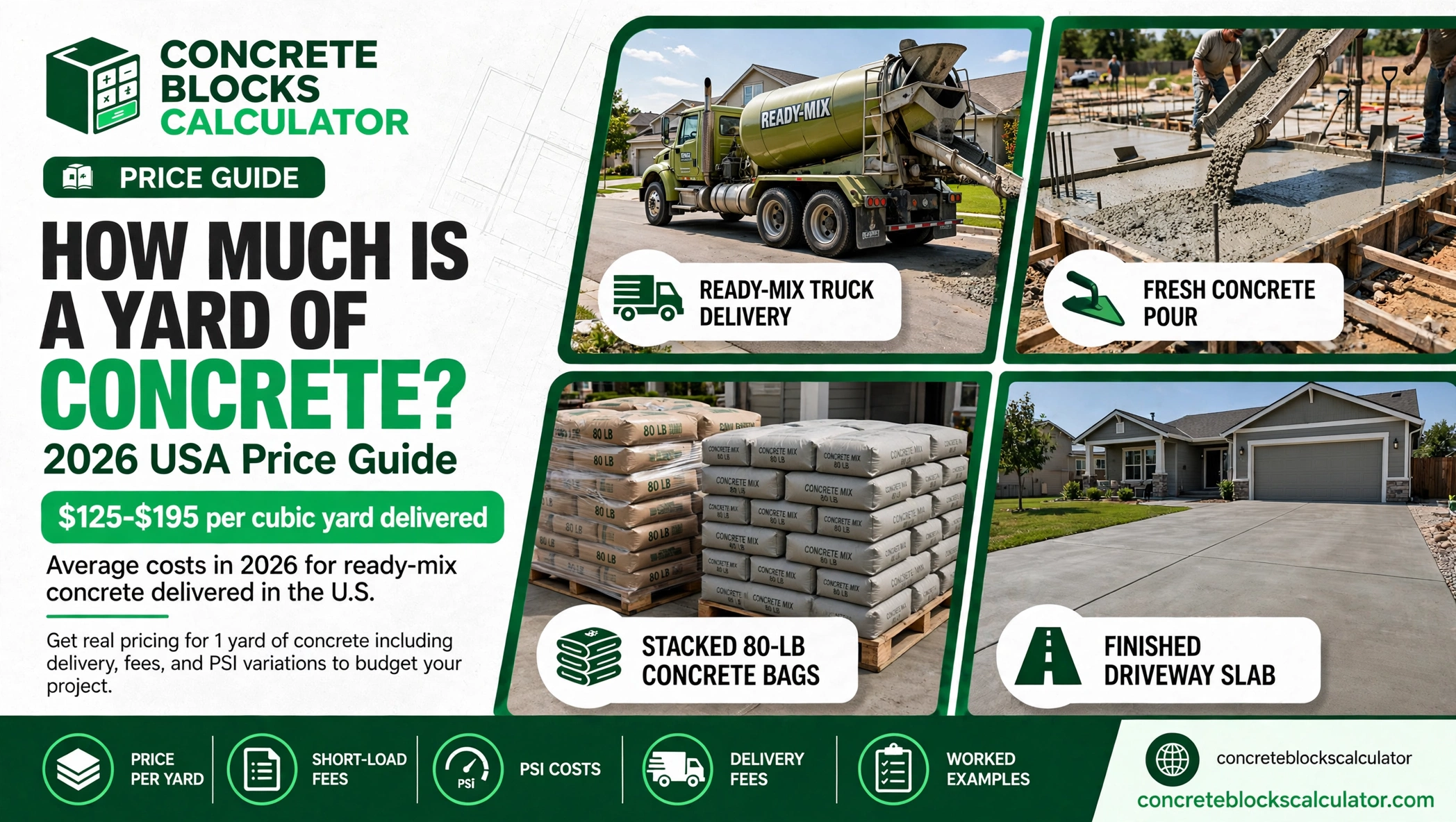
Quick answer: In the USA in 2026, the answer to how much is a yard of a concrete, for standard ready-mix delivered, is $125–$195, before small-order fees — not one fixed national price.
That range is the honest starting point because published 2026 guides do not agree on a single number. The difference is usually what is included: material only, material plus delivery, or a fully installed slab. Once you know which one a figure covers, the quotes become much easier to compare.
At a glance
| What the figure covers | USA planning range, 2026 |
|---|---|
| Standard ready-mix, delivered, per cubic yard | $125–$195 |
| Bagged mix, material only, per cubic-yard equivalent | $225–$360 (45 × 80-lb bags at $5–$8 each) |
| Fully installed slab, per square foot | $6–$12 (site’s live slab-page range) |
How Much Is a Yard of a Concrete Delivered?
Delivered means the truck brings mixed concrete to your site — it does not include forming, placing, finishing, or labor unless the quote says so.
Published 2026 guides illustrate why one headline number is misleading. LawnLove puts standard material at $110–$165 per cubic yard, Angi at about $110–$150, and HomeGuide at about $125–$150 before delivery charges, while Concrete Network’s July 2026 research puts typical ready-mix at $160–$195, with a reported 2025 average of $179.95. Those are not contradictions to pick between; they reflect different markets, mix strengths, and whether delivery is already in the price.
For budgeting, use $125–$195 for standard 3,000–4,000 PSI ready-mix delivered, then replace it with a delivered quote from a batch plant near you. If a quote is well below that range, check whether delivery, a minimum order, or a short-load fee has been left out. If it is well above it, check region, PSI, distance, and extras before assuming you are overpaying.
What does one cubic yard actually mean?
One cubic yard is a volume, not a weight: a cube 3 feet by 3 feet by 3 feet, equal to 27 cubic feet.
At the site’s standard density of 150 lb per cubic foot, that volume weighs about 4,050 lb, or roughly 2 tons. Mix design, aggregate, and moisture move the real weight a little, but 4,000 lb per yard is the planning number most suppliers and contractors use.
That volume also sets coverage. One cubic yard covers about:
| Slab thickness | Area covered by one cubic yard |
|---|---|
| 4 inches | 81 sq ft |
| 5 inches | 65 sq ft |
| 6 inches | 54 sq ft |
| 8 inches | 41 sq ft |
So thickness matters as much as area. Going from 4 inches to 6 inches on the same slab increases the concrete volume by 50%, and the material cost rises with it.
What changes the price per cubic yard?
PSI, region, delivery distance, and extras change the price — the base mix alone does not set your bill.
PSI (pounds per square inch). PSI is compressive strength, usually measured at 28 days. Standard residential mixes run 3,000–4,000 PSI. Each step up in strength typically adds about $5–$15 per cubic yard, because a stronger mix uses more cement.
| Mix strength | Typical use | Price effect |
|---|---|---|
| 2,500–3,000 PSI | Walkways, patios, light slabs | Baseline |
| 3,500–4,000 PSI | Driveways, garage floors, foundations | About $5–$15 more per yard than baseline |
| 5,000 PSI and up | Heavy commercial and structural work | About $10–$20 more per yard than baseline |
- Region. Published guide ranges put the Southeast and parts of the Midwest at the lower end and the Northeast and West Coast at the higher end, mainly because of aggregate supply, transport distance, and local labor rates. Treat a regional range as a check, not a quote.
- Delivery distance. Many plants include a set delivery zone and charge beyond it, by mile or by zone. A low per-yard price from a distant batch plant can lose to a higher per-yard price from a plant nearby once the delivery charge is added.
- Extras at the batch plant. Fiber reinforcement, air entrainment for freeze-thaw resistance, accelerator for cold weather, retarder for hot weather, and integral color each add a few dollars to $25 or more per yard, depending on the product. Only order the ones your job actually needs.
What fees sit on top of the per-yard price?
Short-load, delivery, waiting-time, and pump charges are where small orders get expensive — check them before you book.
- Short-load fee. A mixer truck typically holds 8–10 cubic yards. Ordering well under a full load still uses a truck, a driver, and dispatch time, so plants charge for it. The site’s live figure is $50–$150 for orders under about 8 cubic yards. Other suppliers charge per yard short, or set a minimum order instead, so ask which method your plant uses and at what threshold it starts.
- Delivery charge. Some quotes include delivery in the per-yard price and some add a flat delivery or zone charge. Do not add a delivery charge to a quote that already includes it, and do not assume a material-only quote includes it.
- Waiting time. Plants typically allow a set unloading time, often about 5–7 minutes per cubic yard, then charge per minute or per hour after that. Have forms, rebar or wire mesh, gravel base, and crew ready before the truck arrives.
- Concrete pump. If the truck chute cannot reach the forms, a pump is needed. Guides put line and boom pumps anywhere from about $150–$250 per hour to $800–$1,500 per day, depending on pump type, minimum time, and reach. Price it separately; it is not in the per-yard material price.
- Fuel and weekend charges. Fuel surcharges and Saturday or holiday delivery surcharges vary by plant and are increasingly common. They belong on the quote, not as a surprise on the invoice.
Ready-mix or bags: which is cheaper per cubic yard?
Bags win for very small jobs; a ready-mix truck wins once the volume grows — and the crossover is lower than most people expect.
Bag yields are fixed by the product, and they match the site’s calculator figures: an 80-lb bag yields 0.60 cubic feet, a 60-lb bag yields 0.45, and a 40-lb bag yields 0.30. That means one cubic yard (27 cubic feet) needs:
| Bag size | Bags per cubic yard |
|---|---|
| 80 lb | 45 |
| 60 lb | 60 |
| 40 lb | 90 |
At $5–$8 per 80-lb bag, bagged material alone is $225–$360 per cubic yard, before tax, transport, mixer rental, water, and your labor for handling about 2 tons of dry material per yard. The site’s rule is a good guide: bagged mix is practical under about 0.5 cubic yards, and ready-mix is usually cheaper and faster past about 1 cubic yard, even with a short-load fee. Competitor guides put the crossover a little higher, around 1–1.5 cubic yards, but the direction is the same: do not hand-mix a multi-yard slab to save a delivery fee.
How much concrete do common slabs need?
Use length × width × thickness (in inches) ÷ 324 for cubic yards, then add the site’s default 10% waste allowance.
Run the numbers with our concrete slab calculator for your exact dimensions, but these worked examples show the math:
| Slab | Raw volume | Ordered volume, with 10% waste | Material at $125–$195 per yard |
|---|---|---|---|
| 10 × 10 ft, 4 inches | 1.23 yd³ | 1.36 yd³ | $170–$265 |
| 20 × 20 ft, 4 inches | 4.94 yd³ | 5.43 yd³ | $679–$1,059 |
| 20 × 20 ft, 6 inches | 7.41 yd³ | 8.15 yd³ | $1,019–$1,589 |
Those are material-only figures at the planning range, before short-load, delivery-zone, pump, or tax charges. They are not the installed price: the site’s live installed range for a slab is $6–$12 per square foot, which for a 20 × 20 slab is $2,400 low, $3,400 average, and $4,800 high, because installation adds site prep, forms, reinforcement, placing, and finishing. Keep material and installed figures in separate columns on any quote comparison, or the comparison will mislead you.
How do you get a quote you can compare?
Ask every supplier for the same six items, in writing, and compare delivered totals — not just the per-yard headline.
- PSI and mix type, including any fiber, air entrainment, accelerator, or color.
- Quantity in cubic yards, and whether waste is included or added.
- Delivered price, stating whether delivery and fuel are included.
- Minimum order and short-load terms, including the threshold and whether the fee is flat or per yard.
- Delivery zone and waiting-time allowance, plus the charge after that allowance ends.
- Pump, weekend, and tax treatment, so none of them appear only on the invoice.
Get at least two or three batch plant quotes for the same specification. A $10 per-yard difference is $50 on a 5-yard order and $100 on a 10-yard order, before fees — enough to matter, but not enough to outweigh a plant that cannot deliver on your date or reach your forms.
The bottom line
Budget $125–$195 per cubic yard for standard ready-mix delivered in the USA in 2026, check PSI and region against that range, and price short-load, delivery, waiting-time, and pump charges separately. For a small repair, bags may still be cheaper; for anything over about a yard, a truck is usually the better buy. And never compare a material-only price with an installed price — they answer different questions.
Frequently Asked Questions
What does one cubic yard cover at 4 inches thick?
About 81 square feet. Divide square feet by 81 for a 4-inch slab, then add about 10% for waste.
How many bags make one cubic yard?
45 bags of 80 lb, 60 bags of 60 lb, or 90 bags of 40 lb, based on published bag yields of 0.60, 0.45, and 0.30 cubic feet.
How much does a full mixer truck hold?
Typically 8–10 cubic yards. At the $125–$195 planning range, the material alone is $1,000–$1,950 for a full truck, before any delivery or extra charges.
Does delivery distance change the price?
Yes. Plants use a delivery zone, a mileage charge, or both, so a distant plant can cost more overall even with a lower per-yard price.
Is a higher PSI always worth it?
Not always. Match PSI to the job — 3,000 PSI for most patios and walkways, 4,000 PSI for driveways and garage floors — and pay the step-up only where load or freeze-thaw exposure justifies it.
When do bags beat a ready-mix truck?
For very small jobs, under about 0.5 cubic yards, where a truck minimum or short-load fee would outweigh the bag premium. Past about 1 cubic yard, ready-mix is usually cheaper and faster.
How long does concrete take to reach full strength?
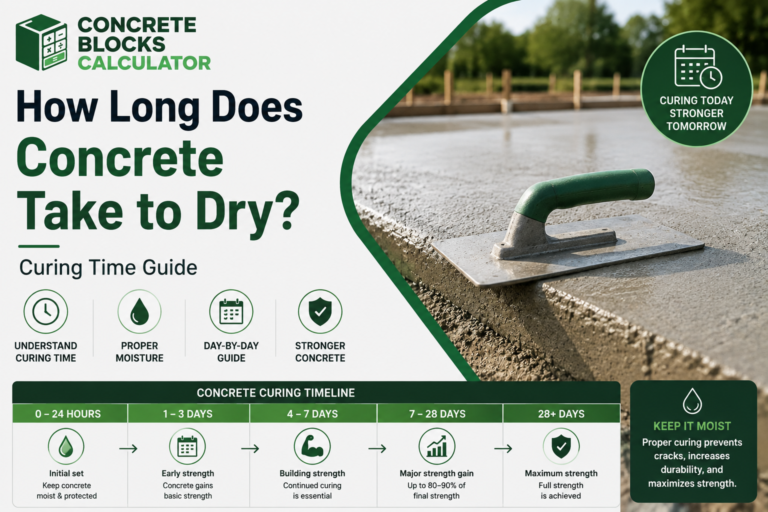
About 28 days for standard mixes, which is why PSI is quoted at 28 days. See the concrete drying and curing guide for the full timeline before sealing or loading a new slab.
2 Comments